Having a serious conversation with a mountain
Kollectiv Folkstone 2026
Having a serious conversation with a mountain
Having a serious conversation with a mountain
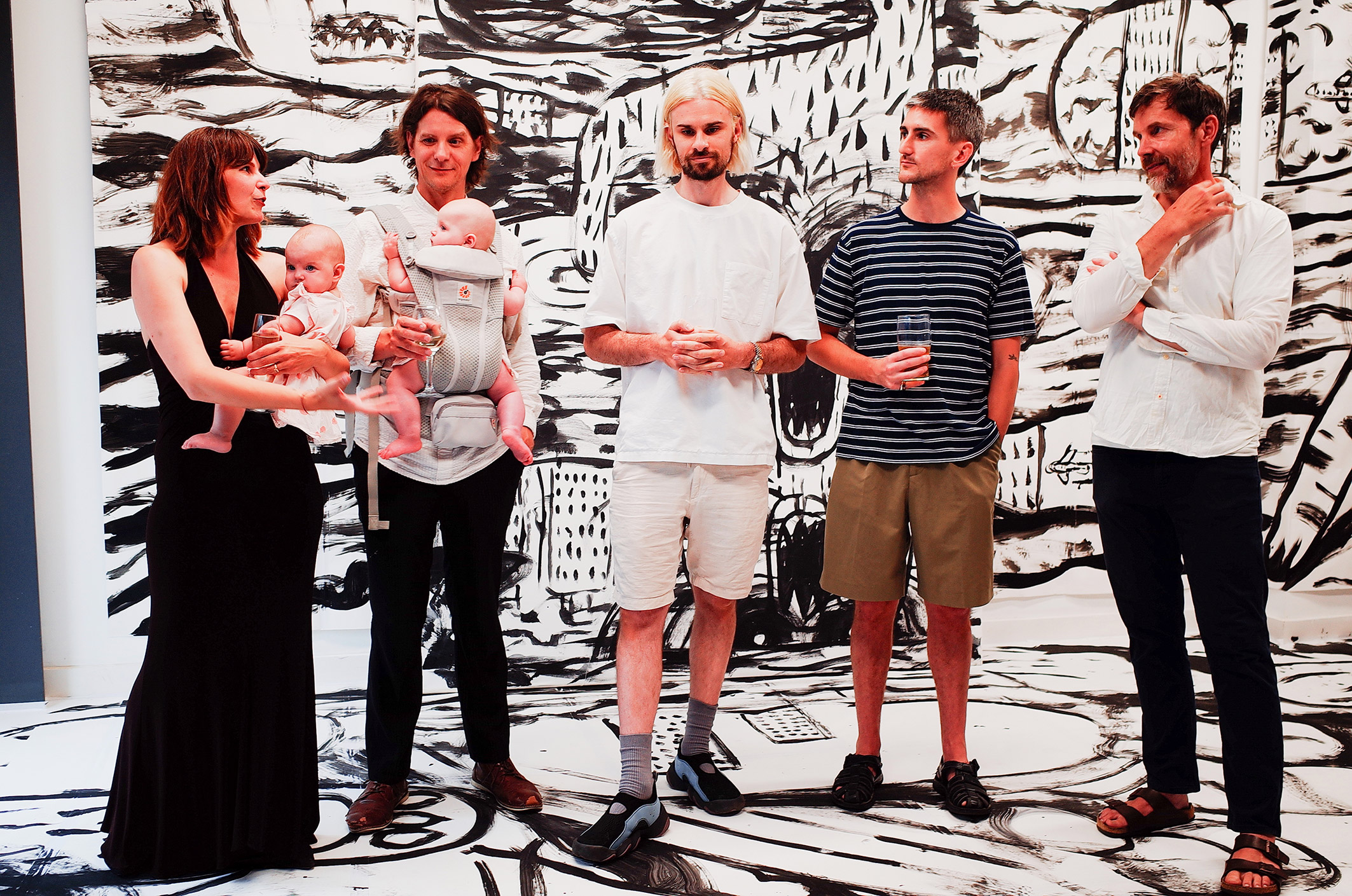
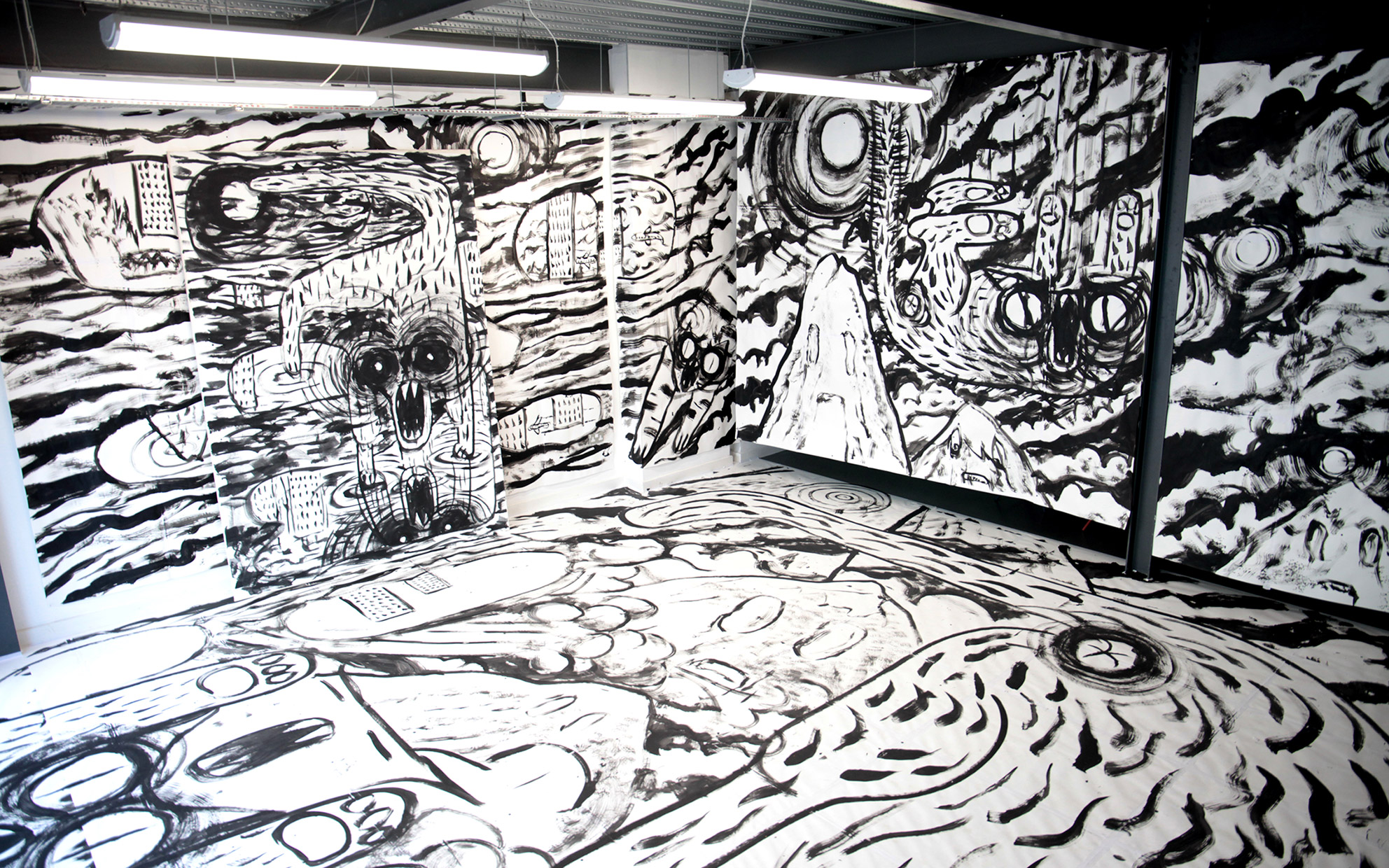
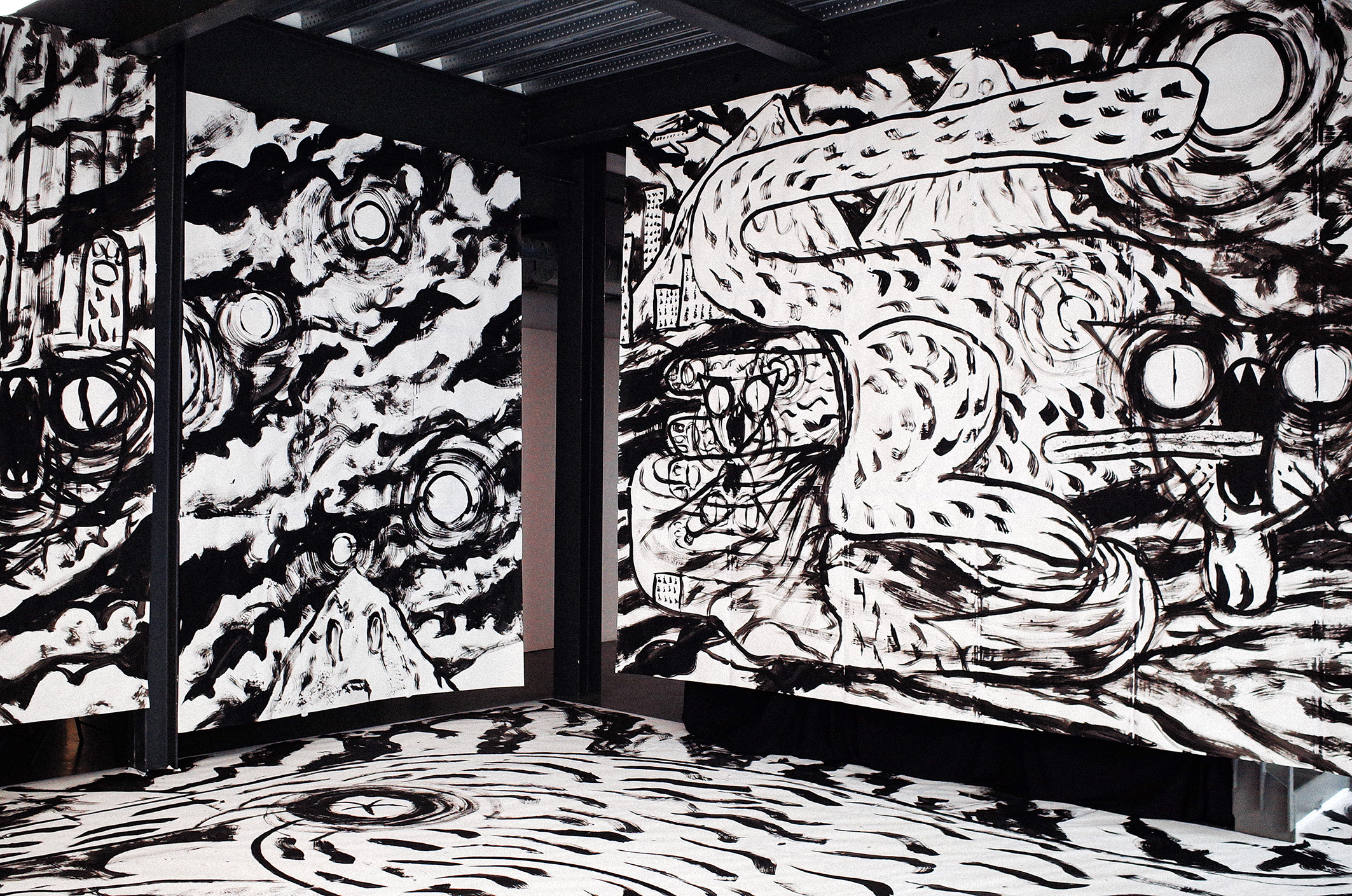
Markus Vater’s Having a Serious Conversation with a Mountain sees the artist cover the walls and floor of kollectiv in paper. Painting directly onto those surfaces, he creates a total environment that makes the viewer feel by turns both large and very small. That’s by design. Exploring a feeling of powerlessness in an age of overlapping crises — or rather, staging the absurd, scatty yet all-too-human attempts to meet that feeling with some kind of grace — the exhibition foregrounds its own inevitable inadequacy.
Vater’s practice moves freely between painting, drawing, animation, and performance. In the installation that envelops viewers as they enter the gallery, his visual language is at its most direct: insistent, wilfully naïve, and attuned to the silly and sustaining narratives of the present moment: the half-formed, half-believed stories we tell ourselves to navigate a pervasive sense of helplessness, whether in the face of xenophobia, violence, greed, war, or environmental destruction. If the style appears irreverent, even unserious, it is precisely because it is tasked with carrying something heavier.
This irreverence extends to the treatment of architectural space. Dissolving conventional boundaries whenever they prove of no use — or little fun — wall and floor become indistinguishable parts of a single continuous field. The gesture is at once expansive and faintly antagonistic: how seriously are we to take this conversation with a mountain in any case? As the artist points out, ‘You can tell a mountain many things, but you won’t be able to force it to do what you want.’
For all its apparent excess, Vater likens the installation to ‘a cave painting — with a little, doing quite a lot’. It is typical of Vater to approach weighty subjects with light tools. David’s slingshot did the trick with Goliath, so why not licks of black paint to grapple with geological giants – with forces, systems and bad actors almost too large to comprehend? This is an installation for all the children told not to draw on the walls or colour outside the lines; to anyone who has felt small but needed, somehow, to be bigger.
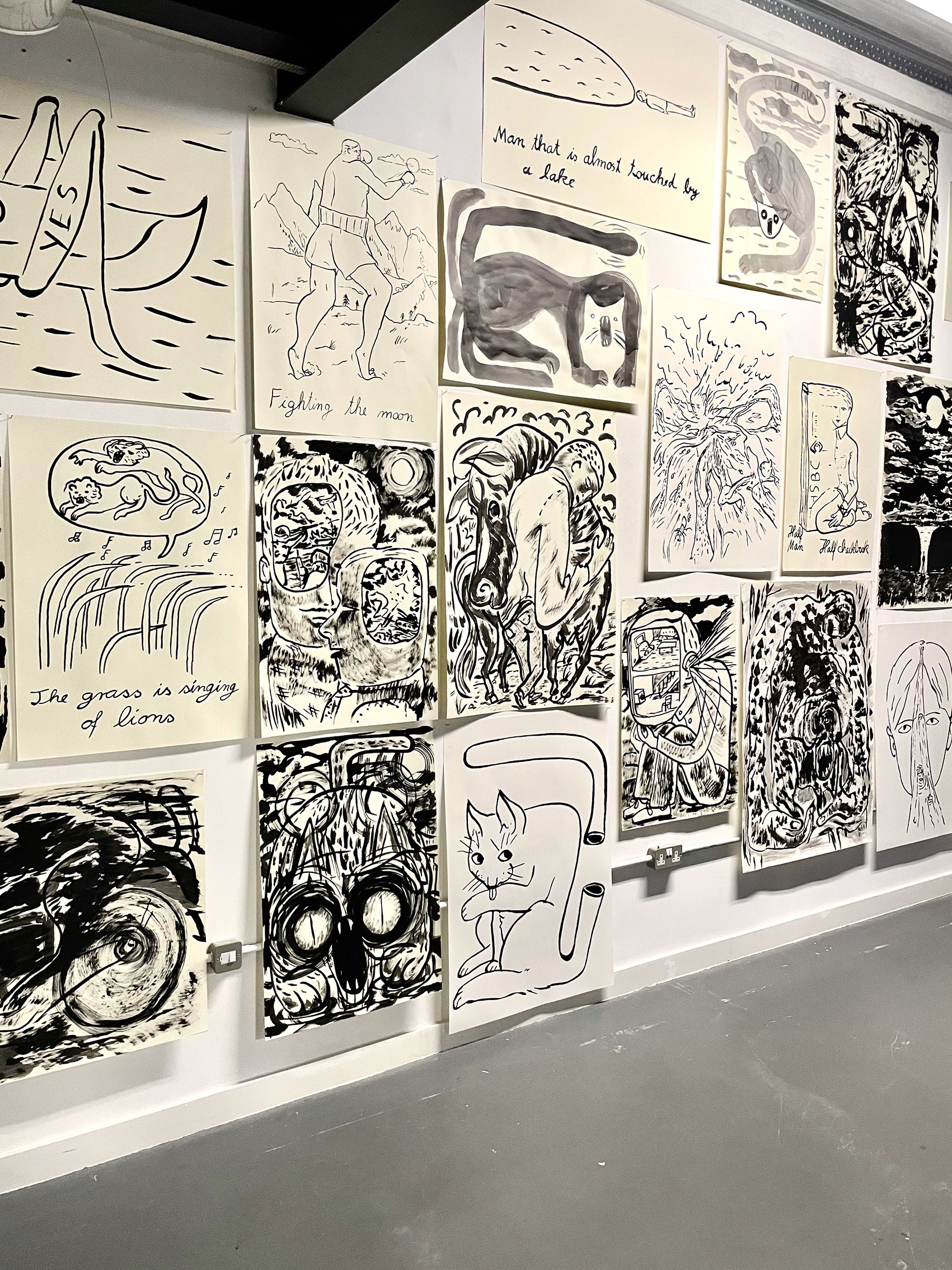
Along with mountains, cats can be infamously indifferent to our wishes — and chief among the recurring motifs here is Vater’s ‘Frightened Cat’. Appearing throughout the exhibition (as well as in previous works) this figure functions less as a subject than as a carrier of affect, like Barry Flanagan’s hares — simultaneously emblematic and elusive. Along with his Dark Dogs, Vater’s Frightened Cats give form and a face to something otherwise nebulous: a background hum of anxiety, that doomy vibe ‘in the air’, a sense of unease that is both personal and collective. Cats are creatures of disruption, inclined to set things in motion — nudge a set of keys off the countertop — and watch what happens next. Vater’s are similarly meddlesome, forever toying with the pictorial field. Their paws trigger ripples, shifts and disturbances, lending the installation a sense of perpetual movement — expressions of instability, but also the cause of it.
In fact, surrounded by image – whether it be drawings, painting or animation – the viewer is never quite sure where to stand, or how to take it all in. One detail draws the eye only to be displaced by another elsewhere. This continual wrong-footing produces a low-level agitation, as though the work were thinking aloud, revising itself in real time.
This effect is further amplified by the texture of Vater’s line itself. Where much of his earlier work is characterised by a singular, economical thread, here the ‘rules’ are transgressed. The lines are loose, frayed, they double back, and hesitate, each mark appearing as both an assertion and a revision. There is a frantic quality, a sense of sketching as thinking, the image as a process still unfolding.
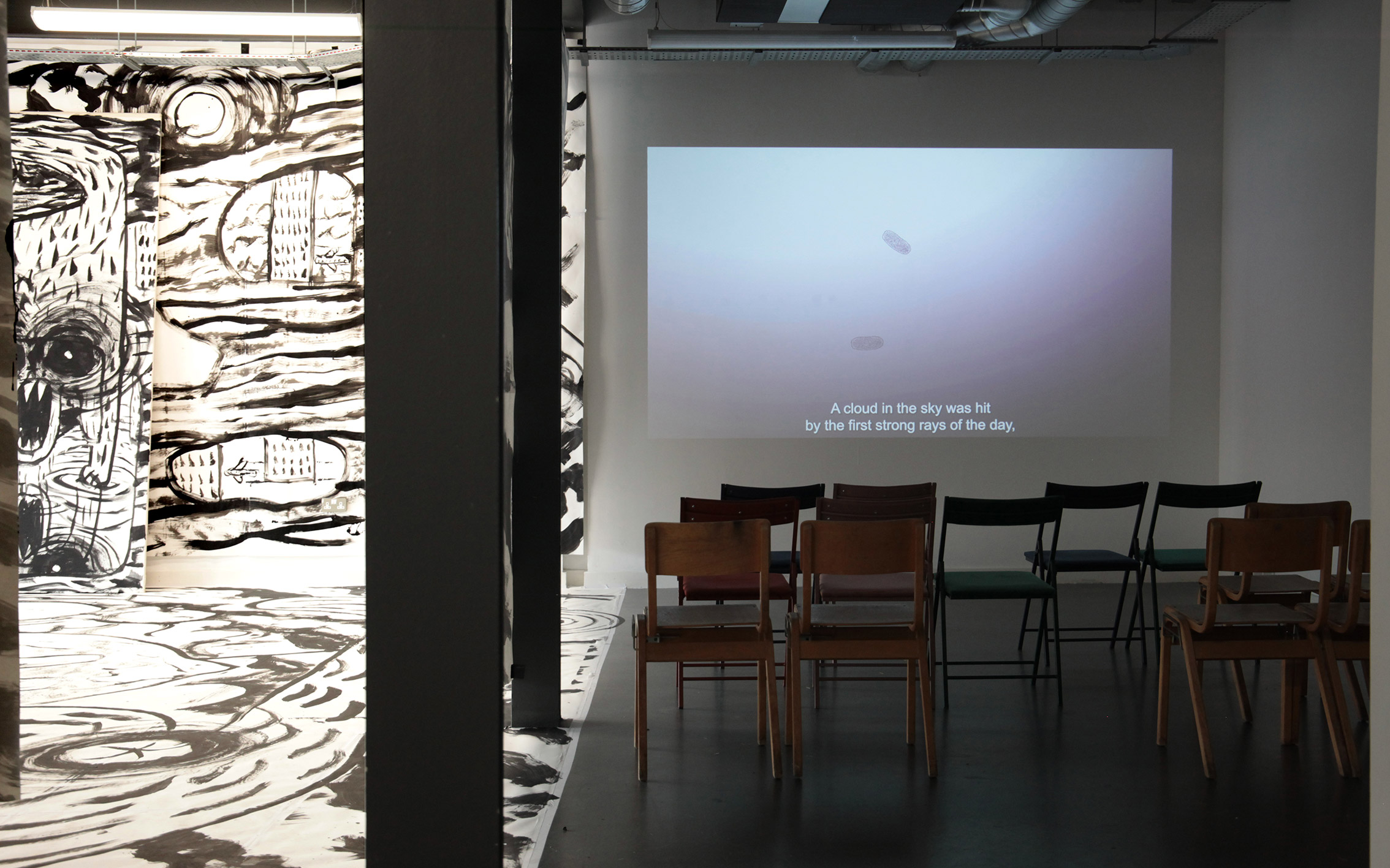
Included in the exhibition is Chaos (2024), an animation that presents a series of origin myths. Agnostic, playful, they represent the stories we tell ourselves to maintain a sense of order over an unfeeling universe, as well as the narratives people use to impose chaos or shape societies: religion, nationhood, economics. One exists within the other; the collective and the idiosyncratic are never entirely separate.
At moments the exhibition resembles what pop-culture wiki tvtropes.org lists as a ‘Room Full of Crazy’, walls covered edge to edge with diagrams, notes and images in an attempt to externalise an inner state of overwhelm. Between madness and philosophy, there are echoes of the 'serious' conversations that take place in the liminal sanatorium of Thomas Mann's The Magic Mountain (1924), a microcosm of a Europe drifting towards catastrophe. Set in Davos, Switzerland, the novel offers an uncanny precursor to the now annual pilgrimage of political and economic elites. Vater’s exhibition provides another invitation to gather in a place suspended somewhere between diagnosis and action. Mountains appear quite differently depending on whether you are looking up or peering down.
Provisional, alive to a world in continual flux, Having a Serious Conversation with a Mountain frames attention itself as one of the few remaining spaces in which power is available to us. Nothing here holds still for long. That, perhaps, is the point: to think in motion. Even when the ground feels fixed, indifferent. (Sammi Gale , 2026)
Having a serious conversation with a mountain